Pricing for a custom SaaS app feels like a black box. The biggest surprise isn’t the tech stack , it’s how little agencies actually reveal about cost. Below we break down the real cost drivers, show typical price bands, compare engagement models, and expose hidden fees so you can budget with confidence.
What Actually Drives Custom SaaS Development Costs
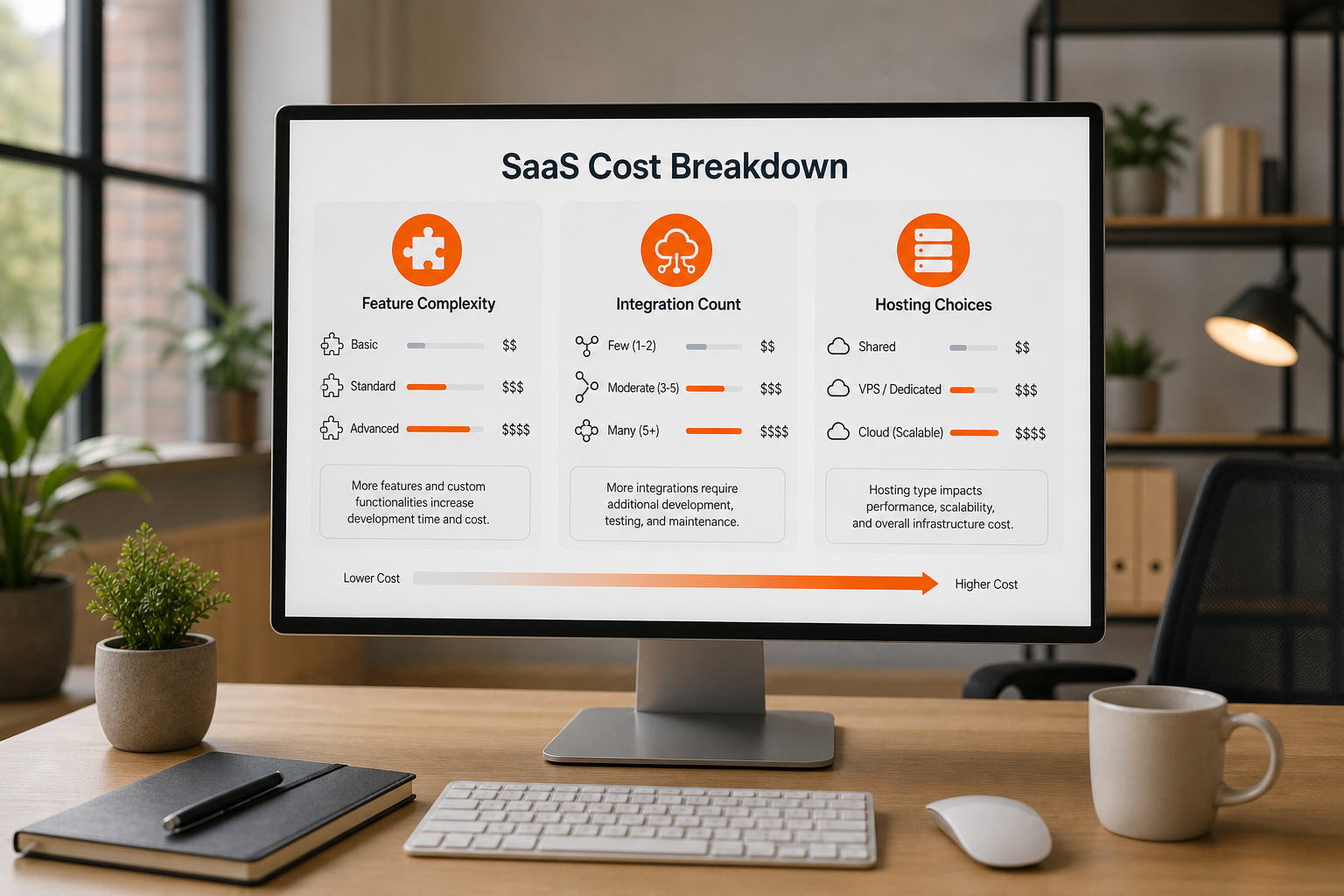
Every line item on a SaaS quote ties back to one of three pillars: features, integrations, and infrastructure. A feature set that includes real‑time analytics or AI will demand more engineering hours than a simple user‑login flow. Complex business logic also means deeper testing and longer QA cycles.
Integrations are another cost multiplier. Hooking into payment gateways, CRM platforms, or third‑party APIs adds development time and creates ongoing maintenance commitments. Each additional API call introduces another point of failure that must be monitored and secured.
Finally, the choice of cloud host shapes both the upfront spend and the long‑term bill. Cloud providers typically charge per‑use, so a well‑architected, auto‑scaling design can keep costs low, but over‑provisioned resources quickly inflate the bill. Compute, storage, and data‑transfer each add a line to the invoice.
Understanding these three levers helps you spot why two vendors can quote wildly different totals for the same feature list.
For a visual summary, see the illustration below.
Lakeway Web Development follows a transparent discovery process that isolates each of these drivers early. We map feature priority, catalog required integrations, and model cloud usage before any code is written, so you see where every dollar goes.
Typical Price Ranges: From MVP to Enterprise SaaS
Pricing scales with scope. A lean MVP that validates a core hypothesis can start around $5,000 – $20,000, especially if you use a limited feature set and a single third‑party integration. Once you add multi‑tenant architecture, advanced analytics, and AI‑driven components, the budget increases significantly for a mid‑scale product.
Enterprise‑grade platforms that serve thousands of users, require compliance certifications (HIPAA, GDPR), and host multiple data centers carry substantially higher costs. These large‑scale deployments need strong security, multi‑region redundancy, and continuous performance tuning, all of which add to the overall investment.
Lakeway's mid‑size focus means we often land in the mid‑range band, delivering a scalable product without the overhead of giant enterprises.
Engagement Models: Hourly, Fixed-Price, or Dedicated Team
How you pay can change the risk profile of a project. An hourly rate offers flexibility but can lead to open‑ended budgets if scope isn’t tightly managed. Fixed‑price contracts lock cost but demand crystal‑clear requirements up front. A dedicated team blends predictability with agility, billing a monthly fee for a set group of engineers.
Hourly engagements work best when you have a well‑defined backlog and can actively manage the developers. Fixed‑price is safer for short, clearly bounded MVPs where you can lock down features early. Dedicated teams shine on longer, evolving products because the same engineers stay with the codebase, reducing ramp‑up time.
Here’s a quick visual on the trade‑offs:
When you choose a partner, ask for a clear breakdown of what’s covered under each model. Lakeway’s standard approach is a hybrid: a fixed‑price discovery phase followed by a dedicated‑team execution phase, giving you price certainty and the flexibility to adapt as the product evolves.
Read more about how we structure our SaaS projects in Best SaaS Development Services Guide 2026 - Lakeway Web Development.
Hidden Costs That Catch SaaS Buyers Off Guard
Even after the contract signs, expenses keep creeping in. Security audits, especially for regulated industries, often add $10K , $30K because they require specialized testing and remediation. Ongoing compliance updates (e.g., GDPR, HIPAA) become a recurring line item.
Post‑launch maintenance is another surprise. Many vendors quote a development fee but forget that fixing bugs, updating libraries, and scaling infrastructure can cost 15% , 25% of the original spend each year. Senior developer salaries drive a large chunk of that recurring cost.
License fees for third‑party components, such as AI libraries or analytics SDKs, are easy to overlook. They may start cheap but grow with usage, turning a $5,000 add‑on into a $50,000 annual charge.
Finally, knowledge transfer is often sold as a "hand‑off" but can require weeks of additional consulting to get your internal team up to speed.

Lakeway includes a post‑launch support package that covers security patches and routine scaling, so you won't face surprise invoices after go‑live.
In‑House vs Agency vs Freelancer: Which Fits Your Budget
Choosing who builds your SaaS is a budgeting decision as much as a talent one. An in‑house team gives you full control but carries significant annual overhead for salaries, benefits, and tooling. Agencies typically bundle work into fixed‑price MVP packages, with rates and package sizes varying widely depending on scope and provider.
Freelancers may quote lower hourly rates, but you inherit coordination overhead, risk of delivery gaps, and possible IP ambiguities. The total cost of ownership for freelancers often exceeds agency costs once you factor in hidden coordination and risk premiums.
Lakeway sits in the agency tier but differentiates itself with AI‑powered search and smooth system integration that cut development time for mid‑size clients. We also provide clear pricing sheets and a dedicated project manager, lowering the coordination burden.
For teams focused on measuring ROI, engineering intelligence tools can help track the financial impact of each development hour and keep your custom SaaS development pricing on target.
FAQ
How do I estimate the cost of a custom SaaS project?
The cost depends on feature complexity, integration count, and hosting needs. Start by defining a core MVP, then add a contingency of 20% for hidden expenses like security audits and post‑launch support.
What engagement model gives the most price certainty?
Fixed‑price contracts provide the most certainty for well‑scoped MVPs because the total is agreed up front and changes are handled via change orders.
Can I mix hourly and fixed‑price billing?
Yes. Many agencies use a fixed‑price discovery phase followed by hourly rates for ongoing enhancements, letting you lock early costs while staying flexible later.
Do freelancers ever cost less than agencies?
Freelancers can be cheaper on paper, but coordination overhead, risk of missed deadlines, and potential rework often make the total cost higher than an agency’s bundled price.
How important is post‑launch support?
Critical. Ongoing maintenance, security patches, and scaling adjustments typically cost 15% , 25% of the original build each year, so factor that into your long‑term budget.
Conclusion
If you need a transparent, mid‑size‑focused partner that couples AI‑powered search with solid integration expertise, Lakeway Web Development is the clear choice. Reach out through our site to schedule a discovery call and get a detailed cost estimate tailored to your SaaS vision.