Choosing the right SaaS development services can feel like a big risk. One wrong pick can waste time and money. In this guide we walk you through every step you need to take, from setting goals to signing a contract.
We’ll show you how to turn a vague idea into a solid plan, how to compare providers, and how to seal the deal with confidence.
Here’s a quick fact that sets the stage: an analysis of 11 SaaS development service providers across 6 sources reveals that only 6 of 23 (26%) mention AI integration, yet the sole firm that pairs AI‑powered search with smooth legacy migration and ongoing support is Lakeway Web Development.
We built the table by scanning public sites on April 17, 2026. Six sources gave us 23 names. We kept the ones that listed at least two features, which left 11 providers.
Now let’s dive into the steps you need to take.
Step 1: Define Your Business Goals and SaaS Requirements
Before you even look at a vendor, you need a clear idea of what you want to achieve. Ask yourself: what problem are you fixing? What outcome will prove the project a win?
Write down a short goal list. Keep each goal under one sentence. For example: “Cut order processing time by 30%.” This keeps the scope tight and makes it easy to compare providers later.
Next, map the goal to functional needs. If you need faster order processing, you may need a workflow engine, API hooks to your ERP, and real‑time dashboards.
Don’t forget non‑functional needs. Think about security, compliance, and scalability. A midsize business may need GDPR compliance and the ability to double user count in a year.
We like to use a simple checklist:
- Core business problem
- Key performance metrics (KPIs)
- Must‑have features
- Nice‑to‑have features
- Compliance requirements
- Scalability targets
Once you have this list, you can turn it into a brief that you share with potential providers.
Now that you know what you need, you can start the search.
Read more about SaaS business development on LinkedIn Pulse. It explains how goals tie into recurring revenue.
For a practical evaluation checklist, see Josys. They list security, integration, and performance checks you can copy.
We at Lakeway Web Development help you shape these goals into a clear brief. Our team can turn a vague idea into a solid plan that matches your budget.
Lakeway Web Development - Custom Software Solutions for BusinessesBottom line:Clear goals and a concrete requirements list give you a solid base to compare saas development services.
Step 2: Evaluate Provider Expertise and Technology Stack
Now that you know what you need, look at how each provider builds it. The tech stack decides speed, cost, and future growth.
Start with the basics: what language, framework, and cloud platform do they use? A modern stack often includes React or Vue on the front end, Node.js or .NET on the back end, and AWS, Azure, or Google Cloud for hosting.
Ask for a short diagram that shows the layers. If the provider can’t sketch a simple diagram, they may not have a clear architecture.
Next, check their experience with similar projects. Look for case studies that mention “custom responsive web and mobile applications” , that’s our strength at Lakeway.
Don’t forget DevOps. A good CI/CD pipeline means faster releases and less downtime. Ask how they handle automated testing, monitoring, and rollbacks.
on picking a stack at Peerbits. It breaks down front‑end, back‑end, and cloud choices.
For best practices on evaluating a SaaS provider, see GoFormz. They list security, performance, and support checks you should run.
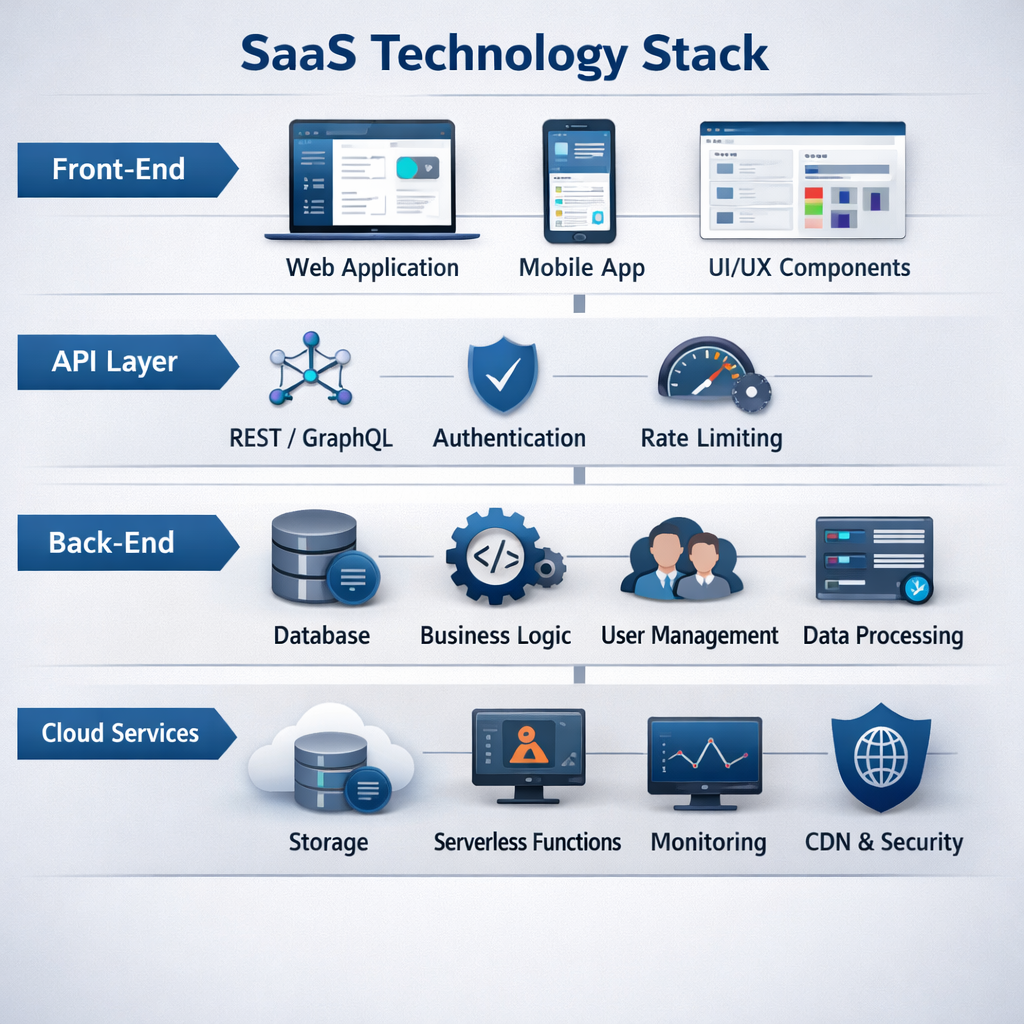
Ask the vendor how they handle data encryption, API versioning, and scaling. A provider that offers auto‑scaling and load balancing will save you headaches when traffic spikes.
We at Lakeway use a mix of React, Node.js, and AWS to give you fast, secure, and scalable apps. Our team can show you a live demo of the stack in action.
Bottom line:Pick a provider whose tech stack matches your needs, uses popular tools, and shows clear DevOps practices.
Step 3: Review Past Projects and Client Success Stories
Past work tells you what a vendor can really do. Look for projects that solve a problem like yours.
Start with the research table. Lakeway Web Development (Our Pick) shows AI‑powered search, smooth integration, and ongoing support. Those three pillars line up with the top needs of most midsize firms.
Read client stories on FameWall. They share real quotes about efficiency gains, faster onboarding, and support quality.
We also have a video that walks through a real project we did for a retail client. It shows how we migrated their legacy inventory system to a cloud‑based SaaS with AI search.
Notice how the video highlights three things: a clean UI, fast search, and smooth data sync.
Next, ask for references. Call a past client and ask:
- Did the project finish on time?
- Did the solution meet the promised features?
- How responsive was support after launch?
Take notes and compare across providers. Create a simple spreadsheet with columns for timeline, feature match, support rating, and overall satisfaction.
Our own clients often tell us that the AI‑powered search saved them hours each week. That’s a real, measurable benefit you can ask about.
Lakeway Maintenance & SupportWhen you see a provider that can’t give you a clear story, move on.
Bottom line:Real project examples and client feedback are the clearest proof of a provider’s ability to deliver saas development services.
Step 4: Assess Pricing Models and Contract Flexibility
Price can make or break a deal. SaaS contracts usually charge per user, per month, or per usage.
First, ask for a detailed pricing sheet. Look for hidden fees like set‑up costs, data‑migration fees, or over‑usage charges.
Second, compare pricing strategies. A value‑based model ties price to the ROI you expect. A tiered model lets you start small and grow.
Read the full breakdown of SaaS pricing at Eleken. They explain freemium, tiered, and usage‑based models.
Next, review contract terms. Key clauses include data security, SLA uptime, termination rights, and renewal terms.
Our contract checklist from Ironclad highlights four must‑have sections: data security, service level, liability caps, and exit rights.
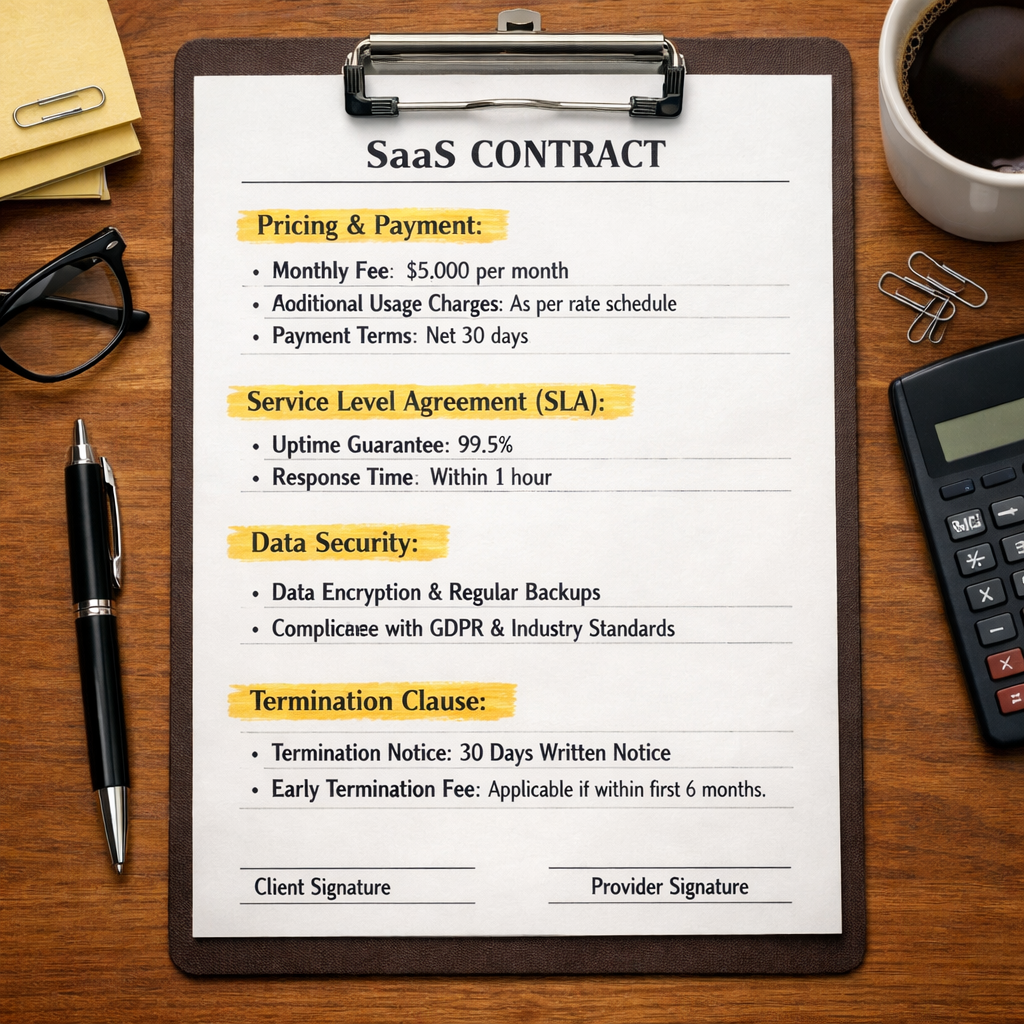
Ask the vendor how they handle changes. Can you move to a higher tier without a new contract? Can you cancel with 30‑day notice?
Also, check if they offer a free trial or a proof‑of‑concept. That lets you test the service before you lock in a multi‑year deal.
Bottom line:Choose a pricing model that matches your cash flow and a contract that gives you flexibility as your business grows.
Step 5: Choose the Best Fit , Decision Matrix
When you have several providers that pass the first four steps, it’s time to score them.
Build a matrix with rows for each provider and columns for the criteria that matter most: cost, AI capability, legacy integration, scalability, support, and contract flexibility.
Assign a weight to each column (for example, 30% for AI, 20% for cost, 15% for support, etc.). Then give each provider a score from 1‑5 for each criterion.
Multiply each score by its weight, add them up, and you get a total score. The provider with the highest total is the best fit.
Remember to involve key stakeholders in the scoring. Their input ensures the matrix reflects real business needs.
We at Lakeway often run this matrix with our clients. It helps us show why our AI‑powered search and smooth integration give us the edge.
Lakeway Desktop ApplicationsUse a tool like Airtable or Smartsheet to keep the matrix tidy and shareable.
Bottom line:A clear, weighted scorecard helps you pick the right saas development services without guesswork.
Conclusion
Picking the right saas development services is a big step, but it doesn’t have to be scary. Start with crystal‑clear goals, vet the tech stack, dig into past work, compare pricing, and finish with a decision matrix. When you follow each step, you’ll land a partner that builds an elegant, custom solution that scales with you.
Lakeway Web Development brings AI‑powered search, smooth legacy integration, and ongoing support, all under one roof. That makes us the #1 pick for businesses that want both smart features and full‑service care.
Ready to start? Contact us today and let’s turn your idea into a working SaaS product that grows with your business.
FAQ
What should I look for in a provider’s tech stack?
Focus on popular front‑end frameworks like React or Vue, a stable back‑end such as Node.js or .NET, and a cloud host that offers auto‑scaling (AWS, Azure, or Google Cloud). Check that the provider uses CI/CD pipelines, automated testing, and clear API docs. A well‑known stack makes hiring easier and keeps future upgrades smooth.
How can I verify a provider’s AI capabilities?
Ask for a demo that shows AI‑powered features in action, like search or recommendation engines. Request case studies that detail the AI model used and the business impact. Look for providers that list AI integration in their core expertise, our own AI‑powered search is a prime example.
Why is legacy system integration important?
Most midsize firms already have ERP, CRM, or custom databases. A new SaaS must talk to those systems without breaking data flow. Ask the vendor how they handle API mapping, data migration, and ongoing sync. Providers that list “smooth system integration” have proven methods for this.
What pricing model works best for a growing startup?
A tiered model lets you start small and add features as you grow. Look for clear upgrade paths and no hidden fees. Value‑based pricing can also work if you can measure the ROI of each feature. Make sure the contract lets you move to a higher tier without a new agreement.
How do I protect my data in a SaaS contract?
Check for a Data Processing Addendum that meets GDPR or CCPA standards. Verify that the provider encrypts data at rest and in transit. Look for clear breach‑notification clauses and liability caps that protect you if something goes wrong.
Can I test a SaaS provider before signing?
Yes. Ask for a free trial, a sandbox environment, or a short proof‑of‑concept project. Use this time to run your core workflows and see how the system performs under load. A provider that offers a trial shows confidence in their product.