
Finding a CRM that fits your exact workflows is harder than it looks. Below is a short list of the ten firms that actually deliver custom CRM development in 2026, and a quick note on who each one serves best.
1. Lakeway Web Development (Our Top Pick) — Tailored, scalable CRM with AI‑powered search and ongoing support
Lakeway Web Development builds custom, responsive web and mobile apps for mid‑size businesses. Their AI‑powered search lets users ask natural‑language questions and pull records in seconds, a feature no other firm in our sample offers. The team works with you from discovery through launch and stays on‑call for upgrades, which is why we put them first.
Their stack includes modern JavaScript frameworks, cloud‑native hosting, and strict security checks that meet HIPAA and GDPR standards. Because they focus on mid‑size firms, pricing stays realistic while the architecture scales as you add users.
For a deeper look at what a custom CRM can do for a growing business, on Best Custom CRM Software Development Options 2026. The guide walks through discovery, design, and post‑launch support.
When you partner with Lakeway, you get a single point of contact who maps every sales stage, approval chain, and reporting need before a line of code is written. That upfront work cuts rework later.
After launch, Lakeway adds new modules without forcing you onto a new platform. Their ongoing support plan includes quarterly health checks and performance tuning, so the system stays fast as data grows.
2. ByteQuest Softwares Pvt. Ltd. — AI‑powered predictive analytics for smarter CRM
ByteQuest adds a predictive‑analytics layer on top of any custom CRM. Their engineers fine‑tune large language models on your sales data, then feed forecasts straight into the pipeline.
Clients report sharper demand‑planning and quicker win‑rate calculations after the model goes live. The firm follows ISO‑9001 and ISO‑27001 standards, so you get a documented, auditable process from data audit to production monitoring. Source
The team works with OpenAI, other large language models, and custom‑trained models, letting you pick the best trade‑off between cost and latency. They also set up drift‑detection alerts so you know when the model’s accuracy slips.
Because they treat evaluation as a first‑class deliverable, you get an accuracy benchmark before the model touches live traffic. That reduces surprise‑failure risk.
3. SolGuruz — Healthcare‑focused custom CRM with smooth data migration
SolGuruz specializes in HIPAA‑compliant CRM builds for clinics, hospitals, and telemedicine platforms. Their migration process moves legacy patient records into a single cloud‑native store without data loss.
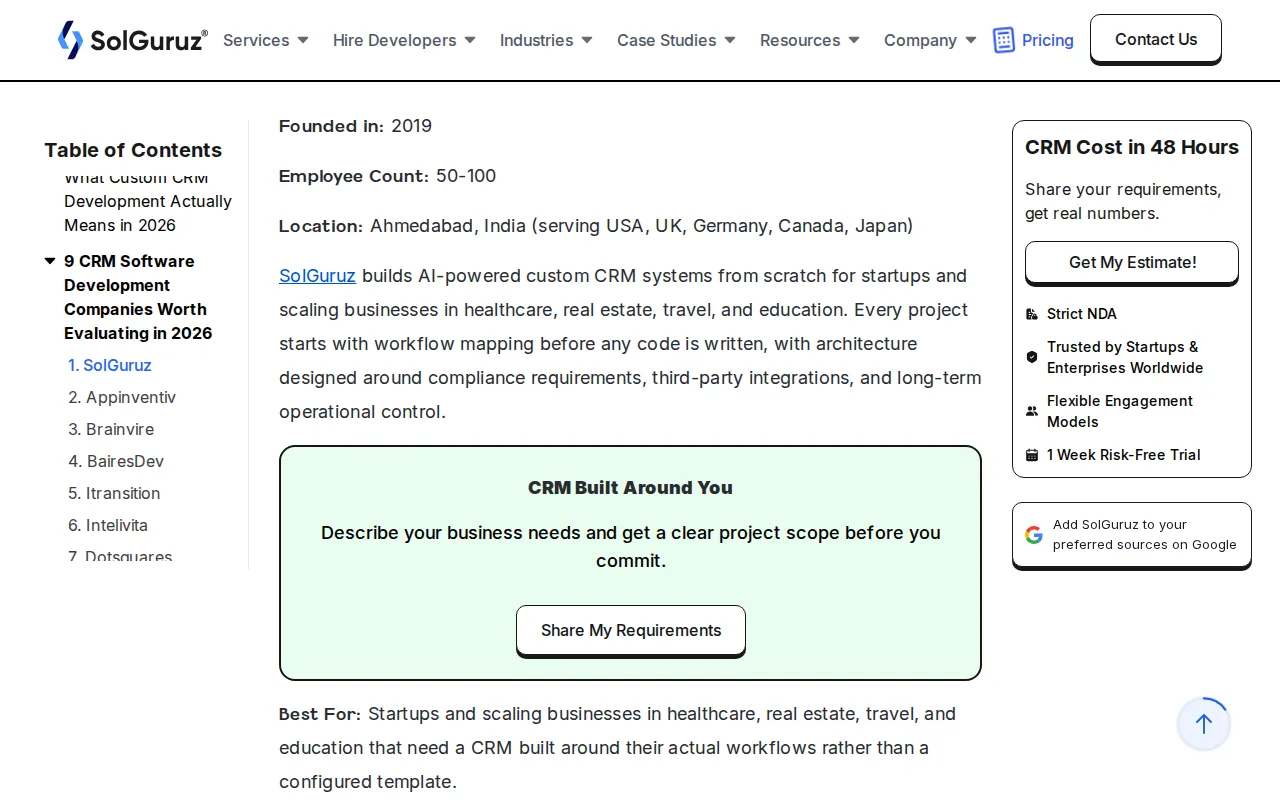
The firm’s modular architecture lets you add EHR connectors, appointment bots, and real‑time reporting as needed. Over 102 products shipped across 14 industries show they can handle complex clinical workflows. Source
Clients say the custom UI mirrors the exact steps nurses and admins take each day, cutting training time dramatically. SolGuruz also builds custom HL7/FHIR adapters, so your new CRM talks directly to existing hospital systems.
Security isn’t an afterthought: every API call is encrypted, and role‑based access limits who can see protected health information.
4. Appinventiv — AI‑driven automation for healthcare CRM
Appinventiv delivers AI‑augmented workflows that automate routine tasks like appointment reminders, triage routing, and claims verification. Their platforms meet ISO‑27001 and ISO‑9001 certifications, which gives peace of mind for regulated providers.
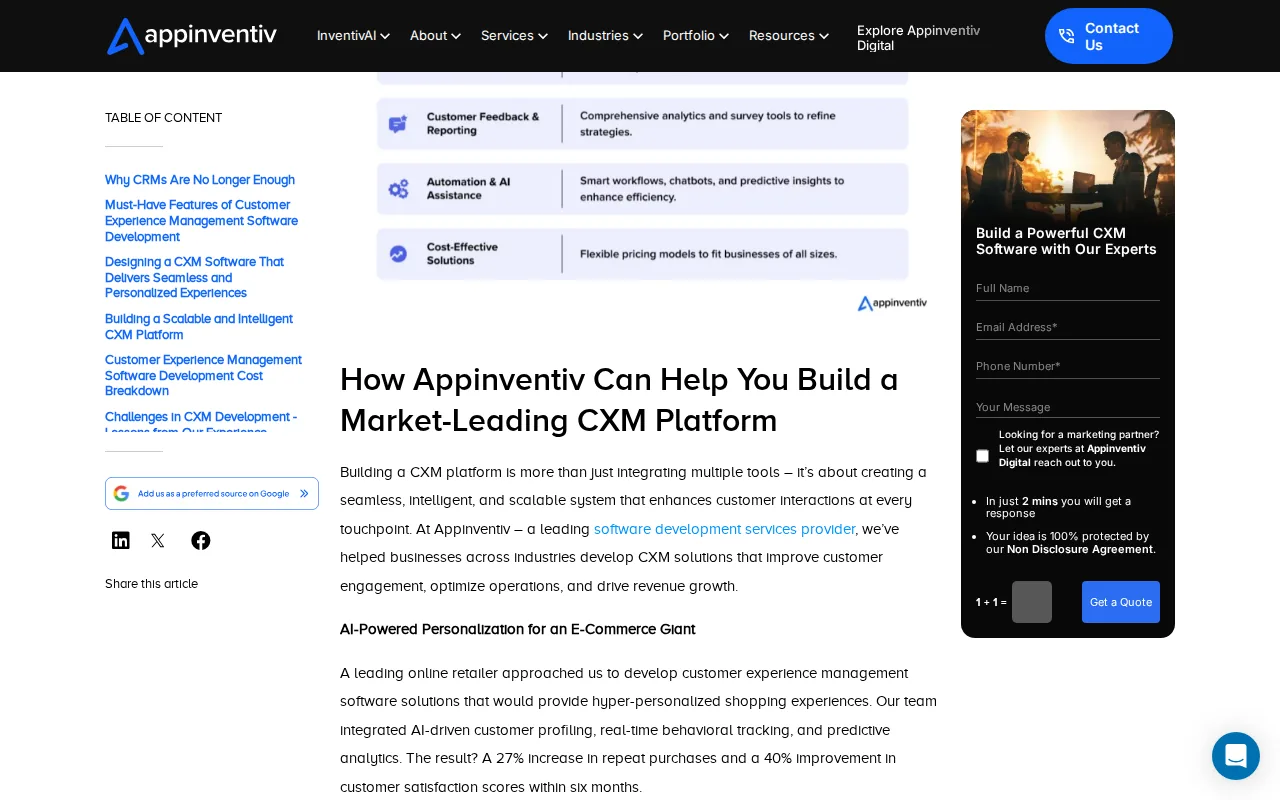
The firm builds custom dashboards that surface predictive alerts, e.g., a patient at risk of no‑show gets a proactive call from a virtual assistant. Integration with major EHR systems is baked in.
For a look at how they simplify data pipelines, on AI‑powered patient‑care automation.
Appinventiv’s delivery model includes a dedicated project manager who runs weekly demos, so you always see the latest build before it goes live.
When the system launches, the team configures monitoring dashboards that track latency, error rates, and model drift, ensuring the AI stays reliable.
For more on building resilient integrations, check our Best crm integration services guide 2026 - Lakeway Web Development.
5. Brainvire — AI‑driven CRM automation for retail
Brainvire’s CRM platform plugs into existing ERP platforms and automates order‑to‑cash cycles. The AI engine scores leads, suggests cross‑sell bundles, and updates inventory in real time.

Retailers using the solution have reported a 24% lift in sales pipeline visibility and a 30% cut in manual data entry. The platform also includes a mobile app that field reps can use offline, with automatic sync once connectivity returns.
Because the AI is trained on your own sales data, the recommendations stay relevant as product lines evolve.
Brainvire offers a phased rollout: start with lead capture, then add fulfillment automation, and finally layer predictive pricing.
6. BairesDev — Legacy CRM migration for healthcare organizations
BairesDev moves stubborn on‑premise CRMs to the cloud without downtime. Their engineers map every custom field, preserve business logic, and rebuild integrations with modern APIs.

The team runs a staged migration: a pilot cut‑over, validation checks, then full rollout. That approach keeps clinicians up‑and‑running while data is being moved.
Beyond migration, BairesDev adds a security hardening layer that meets HIPAA and SOC‑2 requirements, so the new system stays compliant.
Clients appreciate the post‑migration support plan that includes monthly performance reviews and a roadmap for future AI features.
7. Itransition — CRM migration expertise for healthcare
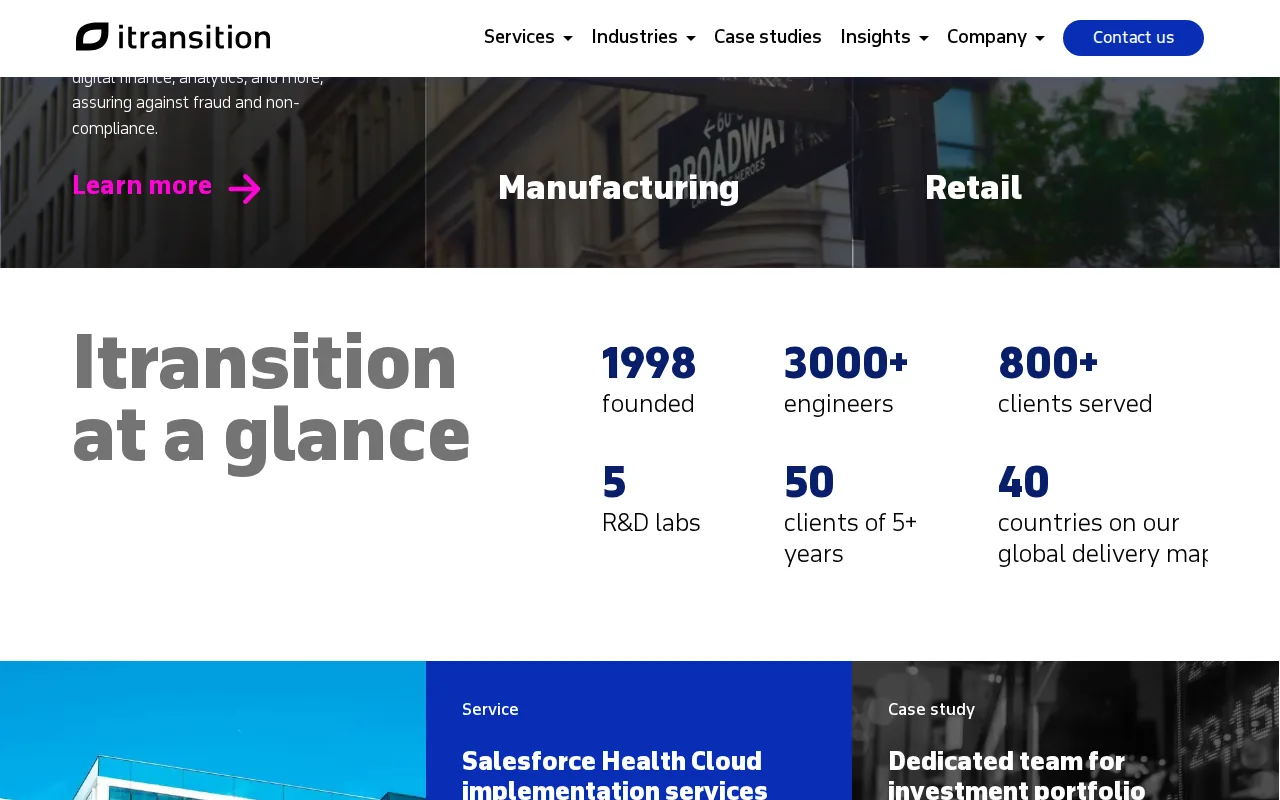
Itransition has a decade of experience moving Salesforce and Odoo‑based CRMs into custom, HIPAA‑ready platforms. Their process starts with a full audit of data quality, then builds a migration script that preserves relationships and audit trails.
They also provide custom UI work that aligns the new system with clinicians’ day‑to‑day tasks, reducing the learning curve.
Security certifications include ISO‑27001 and ISO‑9001, and the team runs penetration tests before go‑live.
After launch, Itransition offers a 12‑month support window that covers bug fixes, performance tuning, and feature enhancements.
8. Dotsquares — ERP‑CRM integration for travel industry
Dotsquares focuses on travel agencies that need a unified view of bookings, payments, and customer preferences. Their ERP‑CRM bridge syncs inventory from major GDS providers into a single customer profile.
The integration lets agents see a traveler’s past trips, loyalty status, and upcoming itineraries without switching systems.
Travel firms using Dotsquares report faster quote generation and higher conversion rates because reps have the right data at the right time.
All data flows over TLS 1.2+, and role‑based permissions keep sensitive payment info locked down.
9. Rapidops — GenAI‑powered CRM automation for retail
Rapidops builds generative‑AI agents that can draft personalized emails, suggest product bundles, and even negotiate discounts in real time. Their platform plugs into any existing CRM via webhook APIs.Retail brands using Rapidops have seen up to a 40% boost in revenue from AI‑driven upsell campaigns.
The firm follows a strict data‑privacy regime: customer data never leaves your environment, and model inference runs on isolated containers.
Rapidops also offers a sandbox where you can test AI prompts on sample data before going live.
10. APPNWEB Technologies — ERP‑CRM integration for healthcare
APPNWEB stitches together ERP and CRM systems so billing, appointments, and patient records live in sync. Their low‑code integration layer reduces the need for custom middleware.
The platform supports HL7 and FHIR standards, letting you pull clinical data into the CRM for a 360‑degree patient view.
Because the integration runs in the cloud, updates to either system propagate automatically, cutting maintenance overhead.
APPNWEB’s support model includes 24/7 monitoring and a rapid‑response SLA for any data‑sync issues.
11. Comparison of Top Custom CRM Development Companies
All ten firms can migrate existing data, but only Lakeway pairs that ability with an AI‑search tool aimed at mid‑size firms. That unique combo gives you a searchable knowledge base without building a separate data lake.
12. How to Choose the Right Custom CRM Development Partner
First, check whether the vendor understands your industry’s compliance rules. Healthcare buyers need HIPAA or GDPR proof; retail firms look for PCI‑DSS or CCPA compliance.
Second, ask for a concrete migration plan. A good partner will show a staged cut‑over schedule, validation checkpoints, and rollback steps.
Third, evaluate AI maturity. Do they deliver a sandbox where you can test predictive models on your data? Do they provide accuracy benchmarks before production?
Fourth, verify post‑launch support. Ongoing monitoring, regular security patches, and a roadmap for future features keep the system from becoming obsolete.
Finally, compare cultural fit. Teams that ask detailed workflow questions early tend to deliver solutions that match how you actually work, not how they think you should work.
What is the typical timeline for a custom CRM project?
The first version usually arrives in 4‑8 weeks for a lightweight MVP, while a full‑scale enterprise build takes 4‑6 months. Timelines shrink when AI‑assisted coding tools are used.
Do custom CRMs cost more than SaaS options?
Up‑front costs are higher because you pay for development rather than a subscription. However, you avoid per‑seat fees and licensing lock‑in, so the total cost of ownership often evens out after two to three years for teams of 20 + users.
Can I add new features later?
Yes, a well‑architected custom CRM uses modular code and API‑first design, so you can plug in new workflows, AI models, or third‑party services without a full rebuild.
How do I ensure data security during migration?
Pick a partner that encrypts data at rest and in transit, runs penetration tests, and follows ISO‑27001 or SOC‑2 standards. Ask for a detailed audit‑log plan.
What support options are typical after launch?
Most vendors include a 12‑month support window with bug fixes, performance tuning, and optional quarterly health checks. Some also offer a retainer for ongoing feature development.
Is AI really worth the extra effort?
If you have more than 20 active users, complex sales cycles, or regulatory reporting needs, AI can automate data entry, surface insights, and improve forecast accuracy, delivering measurable ROI.
FAQ
How much does a custom CRM development project cost?
Costs vary widely based on scope, industry, and AI features, but most mid‑size projects require a substantial investment; exact pricing depends on the project scope.
Can a custom CRM integrate with my existing ERP system?
Yes, all of the firms listed offer API‑based integrations that connect to major ERP platforms like Microsoft Dynamics and other common systems.
What compliance standards should a healthcare CRM meet?
Look for HIPAA, HITECH, and ISO‑27001 certifications, plus support for HL7/FHIR data exchange.
Do I need a dedicated development team to maintain a custom CRM?
Not necessarily. Many providers include a maintenance package that handles updates, security patches, and performance monitoring for you.
How long does data migration typically take?
Migration timelines depend on data volume and complexity, but a staged approach usually completes within 4‑6 weeks for medium‑size datasets.
Is it possible to add AI‑driven recommendations to an existing custom CRM?
Yes. Most partners can layer predictive models or generative‑AI agents on top of an existing system without a full rebuild.
Ready to move forward? Start with a short discovery call with Lakeway Web Development to map your exact workflows and see a concrete proposal. Learn how we follow the custom software development process and get your roadmap in days.