APIs are the glue that hold modern apps together. You need a pattern that fits the data flow, performance needs, and team skill set. Below we break down the leading API design patterns, show how they work, and point out where they can trip you up.
REST API Design Patterns
REST (Representational State Transfer) is the oldest and most widely adopted style. It maps HTTP verbs to CRUD actions on resources that are identified by clean URIs. The approach keeps client and server loosely coupled, so each can evolve without breaking the other. Wikipedia explains the core constraints. A typical REST endpoint might look like/orders/123for a single order, while/ordersreturns a collection.
Because REST relies on standard HTTP, it works with any language or platform. That makes it a safe choice for public APIs, third‑party integrations, and microservices that need simple, stateless communication. The pattern also supports hypermedia links (HATEOAS) to guide clients through possible next actions.

When you need to page through large result sets, you can add cursor‑based pagination to avoid costly offset scans. Idempotency keys let POST calls be retried safely, which is vital for payment or order‑creation flows. These extensions give REST a performance edge that many newer styles claim to own. Business process integration platforms often build on these REST extensions
One caveat: REST can be chatty when clients need only a slice of a resource. Over‑fetching leads to higher bandwidth use on mobile networks.
GraphQL API Design Patterns
GraphQL lets clients ask for exactly the fields they need, avoiding the over‑fetch problem of REST. The schema defines types and relationships, and a single endpoint resolves any query that matches the shape. Federation patterns can stitch multiple GraphQL services into a single supergraph. This federation pattern is useful for large organizations where different teams own separate sub‑graphs.
Because the query describes the data shape, the response is usually smaller, great for mobile apps and dashboards. GraphQL also supports fragments, which let UI components declare their own data needs, keeping the front‑end code tidy.
The main trade‑off is the extra server‑side complexity. You need a query planner, a resolver layer, and careful handling of the N+1 problem, where naïve resolvers fire a separate database call for each requested field. Batching utilities can combine those calls, though they introduce additional maintenance.
If your API must serve many third‑party developers or you need a public contract that stays stable across versions, GraphQL can be harder to version because the schema is exposed directly. In those cases, a well‑documented REST contract may be simpler.
For teams that already use TypeScript, the GraphQL codegen step can generate type‑safe client libraries, but that adds a build step you have to keep in sync.
We often pair GraphQL with a thin REST layer for admin or legacy tools, letting each style play to its strengths. Our API‑first web development services help you choose the right mix
tRPC API Design Patterns
tRPC is a TypeScript‑first RPC framework that treats the TypeScript type system as the API contract. There is no separate schema file or code‑generation step, your server code and client code share the same types.
When you change a request shape, the TypeScript compiler immediately warns every consumer. That eliminates a whole class of runtime bugs caused by mismatched contracts.
Because tRPC sends plain JSON over HTTP (or WebSockets), latency is low. In a production benchmark, cold‑start times were trimmed from 180 ms to 45 ms, and sustained response times fell from 38 ms to 12 ms. The official tRPC docs illustrate the minimal setup steps
tRPC shines for monorepos where the front‑end and back‑end live in the same repo. It lets you roll out new fields quickly without waiting for a schema‑generation pipeline.
One limitation is that tRPC ties you to a TypeScript stack. If you need to expose a public API to non‑TypeScript clients, you’ll have to add a separate OpenAPI layer.
Below is a short video that walks through a production tRPC setup.
When you need fast iteration and type safety across the stack, tRPC is a strong contender.
gRPC and WebSocket Patterns
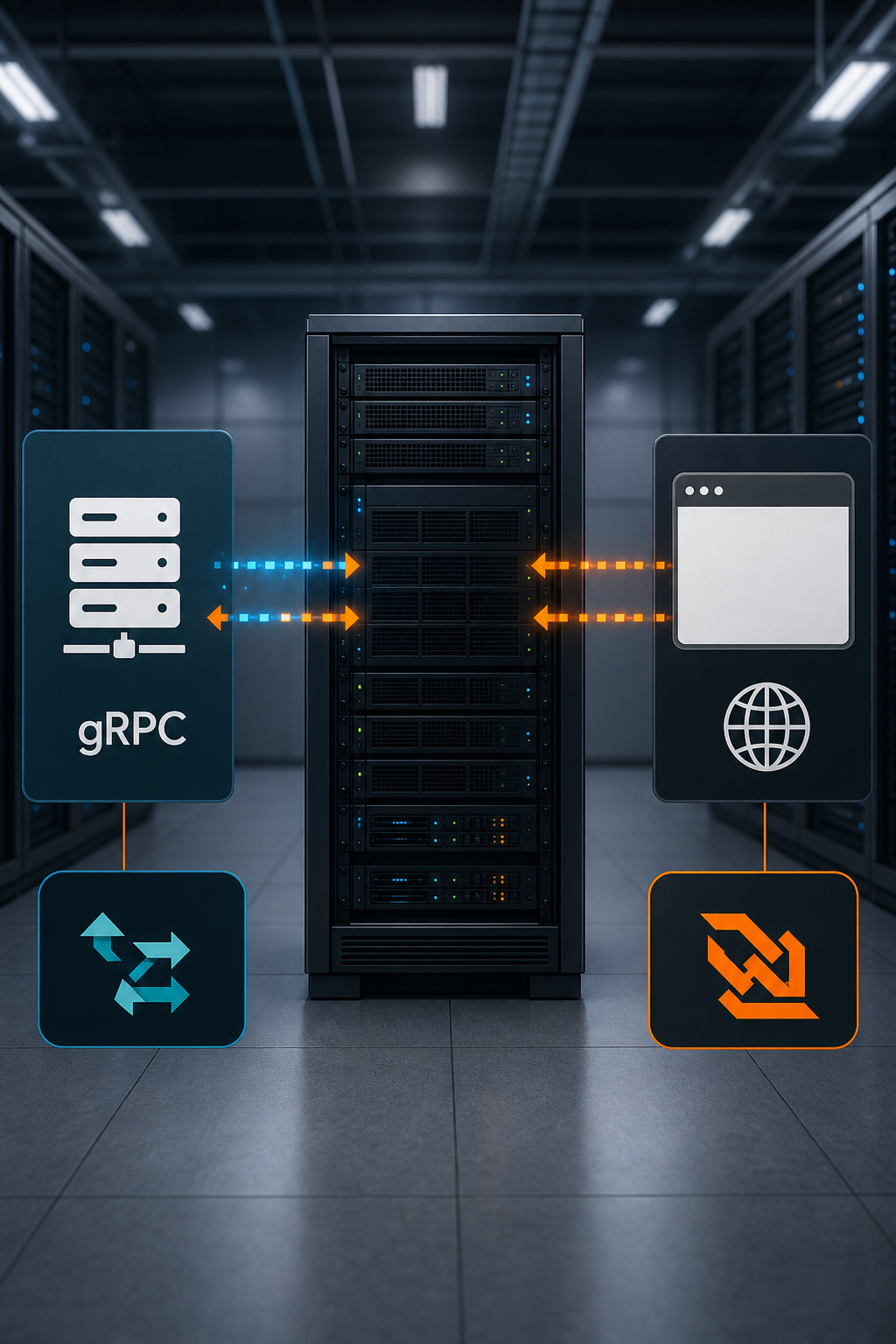
gRPC is a binary‑based RPC framework that uses Protocol Buffers for schema definition. It runs over HTTP/2, giving you built‑in support for bidirectional streaming, flow control, and sub‑10 ms latency. These traits make gRPC a go‑to for high‑performance microservice communication.
Because the contract lives in a .proto file, you get strong type safety across languages. A change in the .proto forces a recompilation step, which catches mismatches early.
WebSocket, on the other hand, provides a persistent, full‑duplex channel between client and server. It’s ideal for live feeds, collaborative editing, or real‑time dashboards. Unlike HTTP polling, a WebSocket push sends data the moment it’s available, saving bandwidth and latency.
Both patterns require careful state management. With gRPC you must handle connection pooling and service discovery. With WebSocket you need to think about reconnection logic and back‑pressure. Custom software integration platforms often combine gRPC for backend services and WebSocket for real‑time front‑end updates
Choosing between them depends on who consumes the API. If you control both ends and need maximum throughput, gRPC wins. If you need a browser‑based, event‑driven channel, WebSocket is the better fit.
Comparative Overview of API Design Patterns
Below is a quick reference that lines up the five patterns we covered. Use it to match a pattern with your project’s priorities.
Pick the pattern that aligns with the data shape, latency needs, and client ecosystem you have.
FAQ
What is the biggest advantage of using REST over GraphQL?
The biggest advantage is its universal compatibility; any HTTP client can talk to a REST API without special libraries. Wikipedia notes that this simplicity drives wide adoption. It also works well with caching proxies.
When should I choose tRPC instead of GraphQL?
Choose tRPC when your front‑end and back‑end share a TypeScript codebase and you want instant type safety without a schema‑generation step. It shines in monorepos where rapid iteration is key.
Can I mix gRPC and REST in the same system?
Yes, many teams expose a public REST façade for external partners while using gRPC internally for microservice communication. This lets you keep external contracts stable and still benefit from gRPC’s performance.
How do I handle versioning with GraphQL?
GraphQL encourages additive changes; you add new fields and deprecate old ones instead of breaking the schema. Clients that don’t need the new fields keep working unchanged.
Is WebSocket suitable for low‑traffic admin dashboards?
It can be overkill for low‑traffic scenarios. If you only need occasional updates, long‑polling or Server‑Sent Events may be simpler to implement.
Conclusion
REST remains the workhorse, but cursor pagination and idempotency keys keep it competitive. For high‑speed internal services, gRPC or tRPC give you the edge, while GraphQL solves over‑fetch problems for rich clients. If you’re not sure which pattern fits, start with a REST base and add a specialized layer as needs evolve. Read more about API design fundamentals to keep your architecture future‑proof.
Ready to put this into practice? Lakeway Web Development was built for exactly this.