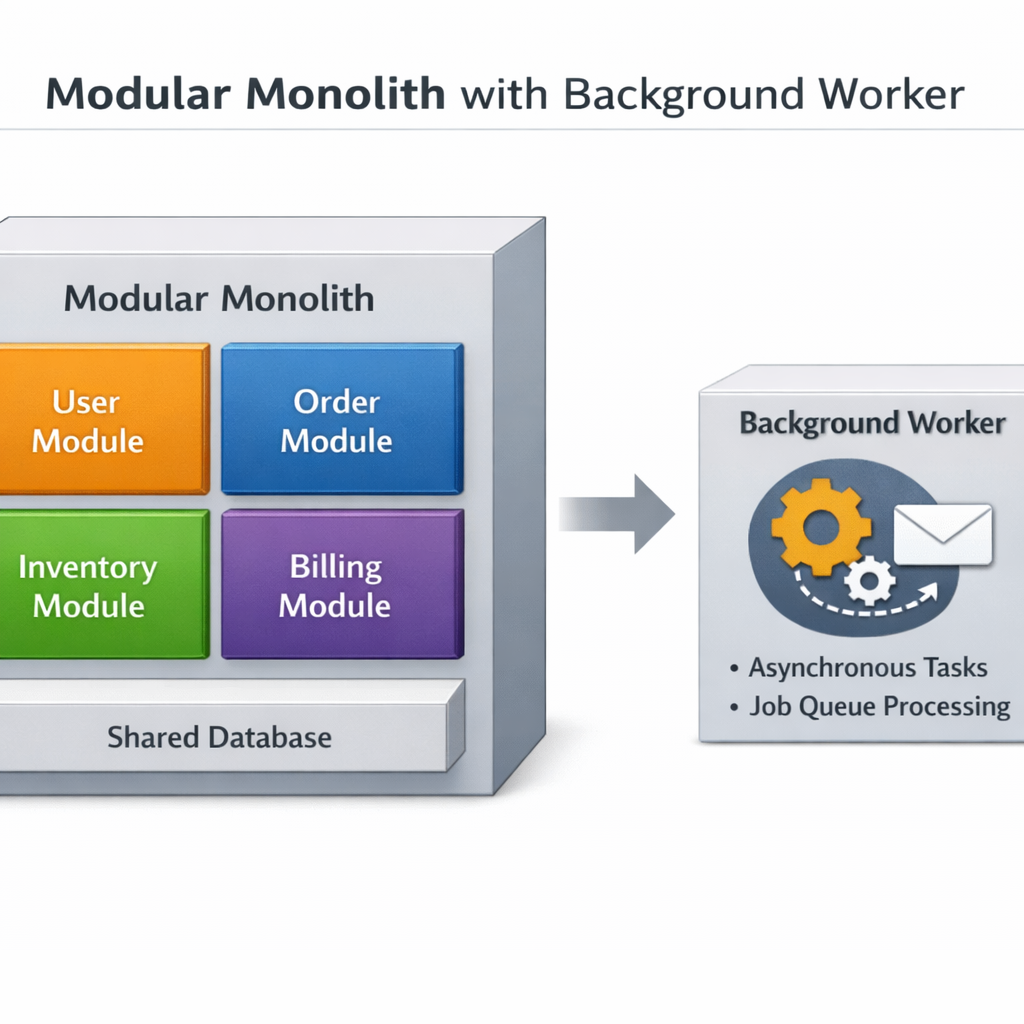
80% of the arguments for microservices can be met by adding a single background worker to a monolith. That surprise shows why the choice isn’t always black‑and‑white. In this guide we’ll break down what each style is, weigh the pros and cons, and give you a clear path to decide which fits your business.
We’ll walk through the core ideas, show real‑world trade‑offs, and end with a quick decision matrix. By the time you finish, you’ll know exactly how to match the right architecture to your goals.
What Is Monolithic Architecture?
A monolithic app lives in one code base. All the UI, business logic, and data access sit together in a single deployable unit. Think of it as a single, tightly‑coupled block that runs on one runtime.
Because everything is together, developers can spin up a new project fast. A small team can write one executable, push it, and watch it work. That speed is why startups often start with a monolith.
But the tight coupling also means a change in one part forces a rebuild of the whole thing. If you add a new feature, you must test the entire stack again. Scaling can become costly because you have to scale the whole app, even if only one component needs more power.
Here’s a simple picture of a monolith: a front‑end UI talks to a server layer, which talks to a single database. All three live in the same process.
According to Wikipedia’s definition of a monolithic application, this style is easy to develop at first but can become a maintenance headache as the code base grows.
Real‑world example: a small e‑commerce startup built its catalog, cart, and checkout in one Node.js project. The launch was quick, but months later the traffic spike on the checkout forced the team to buy a bigger server, even though the catalog stayed quiet.
When you weigh a monolith, ask yourself:
- Is the product scope small enough to stay simple?
- Do you have a limited budget for ops?
- Will the team stay small for the next 12‑18 months?
Answering yes to most of these means a monolith can save time and money.
Bottom line:A monolith is a fast, low‑cost start, yet it can lock you into a single, hard‑to‑scale unit.
What Is Microservices Architecture?
Microservices break an app into many small services. Each service owns its own data and runs in its own process. The services talk over a network , usually HTTP APIs.
This design lets each team own a single service. They can pick the best language or framework for that job, and they can deploy changes without touching the rest of the system.
Netflix is the poster child. In 2009 the company moved from a big monolith to thousands of tiny services. That shift let them ship code dozens of times a day and scale each video‑streaming piece independently.
Microservices also match the cloud. You can containerize a service, push it to Kubernetes, and let the platform spin up more pods when load rises.
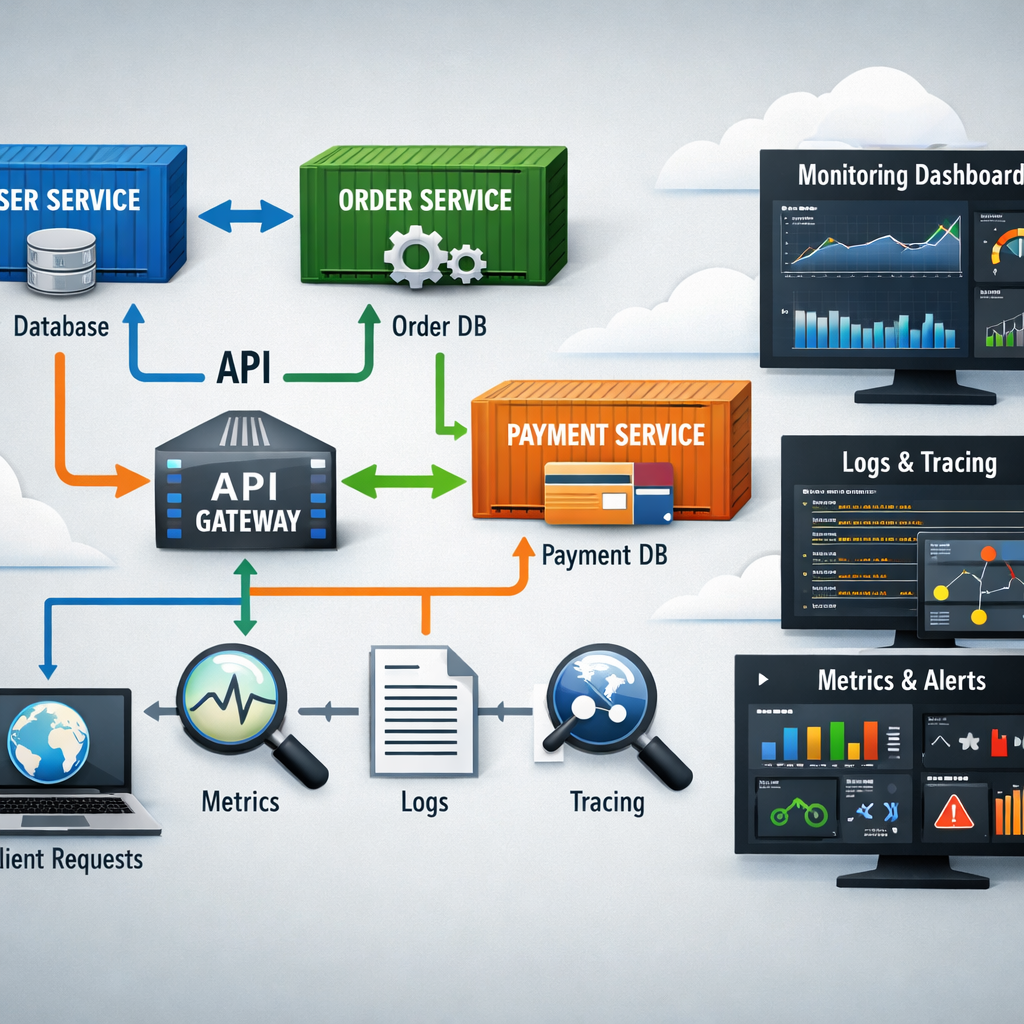
However, the benefits come with price. You need strong DevOps pipelines, monitoring for many moving parts, and a culture that can handle distributed troubleshooting.
Martin Fowler’s classic article on microservices explains that the style isn’t a silver bullet; it simply makes complexity visible and manageable by splitting it into smaller, independent units.
Consider an online banking platform that needs to process transactions, generate statements, and run fraud detection. In a microservice world, each function lives in its own service, so a spike in fraud checks doesn’t slow down statement generation.
When you design microservices, follow the single‑responsibility principle. A service should do one thing well and expose a clear API.
But don’t make services too tiny. A CRUD‑only service that talks to many others can become a “distributed monolith.” Find the sweet spot with domain‑driven design.
Key questions for a microservice approach:
- Do you have the DevOps tooling for automated builds and deployments?
- Can you staff cross‑functional teams that own end‑to‑end services?
- Is the expected traffic high enough to need independent scaling?
Bottom line:Microservices let you ship fast and scale parts independently, yet they add operational complexity that must be planned for.
Key Advantages of Microservices Over Monolithic
When you compare the two, a few clear wins show up for microservices.
First, each service can be scaled on its own. If a geographic‑lookup service gets heavy traffic, you add more instances only for that service. The rest of the app stays at normal size, saving compute cost.
Second, you can use the best tool for each job. One team may write a high‑throughput data‑pipeline in Go, while another builds a UI‑heavy front‑end in JavaScript.
Third, fault isolation improves reliability. If the payment service crashes, the catalog can keep serving pages. Users see a degraded experience, not a total outage.
Fourth, deployment speed rises. Small services mean small code changes, quick CI pipelines, and less risk of breaking unrelated features.
All these points line up with the findings from IBM’s comparison of monolithic and microservices, which notes that independent updates lower the chance of a full‑system failure.
Here’s a quick checklist to see if you need those benefits:
- Do you expect rapid feature growth across many domains?
- Is high availability a core business requirement?
- Do you have teams that can own end‑to‑end services?
Real example: a global retailer split its inventory, checkout, and recommendation engines into separate services. When a flash sale drove checkout traffic up 10×, they added more checkout pods without touching inventory, keeping the site alive.
While the benefits sound great, remember they only materialize when you have the right processes.
Bottom line:The microservice model shines for large, evolving systems that need independent scaling and fast releases.
Challenges and Trade‑offs of Microservices
Microservices are not a free lunch. The biggest hurdle is complexity. You now have many services, each with its own deployment, monitoring, and versioning.
Automation is a must. You need pipelines that can build, test, and push dozens of services daily. Without that, you’ll spend more time coordinating releases than delivering value.
Observability becomes critical. Logs, metrics, and traces must be collected across services to spot the root cause of an issue. A single failure can cascade if you don’t have circuit breakers or timeout strategies.
Team structure matters. Siloed teams that don’t own end‑to‑end services will struggle. Cross‑functional squads that can design, code, and operate a service are the ideal setup.
ThoughtWorks warns that many organizations jump into microservices before they have the required cultural and tooling foundation. The result is a “distributed monolith” where services are tightly coupled through APIs and share databases, losing the intended benefits.
Another trade‑off is operational cost. Running many containers or VMs can add up, especially on public cloud providers. You may also face vendor lock‑in if you rely heavily on a single platform’s managed services.
Here’s a short list of common pitfalls:
- Missing automated testing across service boundaries.
- Inconsistent API contracts leading to breaking changes.
- Over‑splitting services into tiny CRUD endpoints.
- Neglecting data ownership, causing services to read each other’s databases directly.
To avoid these, start with a clear service boundary definition, invest in CI/CD, and set up centralized logging and tracing.
Real‑world cautionary tale: a media platform broke its user‑profile service into separate “likes” and “comments” services but kept them sharing the same database table. When the comment service overloaded, the likes API slowed down, creating a ripple of latency.
Bottom line:The power of microservices comes with added operational and cultural overhead that must be planned for.
Choosing the Right Architecture: Decision Criteria
There’s no one‑size‑fits‑all answer. Your choice should hinge on business goals, team size, budget, and expected growth.
Use this decision matrix to weigh factors. Mark the column that matches your project.
If you’re a startup with a tight budget, the monolithic column will likely score higher. If you expect rapid growth, a global user base, or need to adopt new tech stacks fast, the microservices column will win.
Lakeway Web Development can help you start with a modular monolith and later migrate to microservices as your needs evolve. That path lets you get to market fast while keeping the door open for future scaling.
Another practical tip: run a spike experiment. Pick one non‑critical feature, extract it as a service, and measure the impact on deployment time and resource usage.
Bottom line:Use the matrix to compare needs; choose monolith for speed and cost, microservices for scalability and flexibility.
FAQ
What’s the main difference between microservices and a monolithic architecture?
Microservices split an app into many independent services that run in separate processes and communicate over a network. A monolith keeps all code, UI, and data access together in one deployable unit. The split gives you independent scaling and faster releases, while the monolith offers simplicity and lower operational overhead.
When should a startup choose a monolithic approach?
If you have a small team, limited budget, and need to launch quickly, a monolith lets you ship a working product in weeks rather than months. It also works well when the feature set is narrow and you don’t expect massive traffic spikes in the first year.
Can I add a background worker to a monolith to get microservice‑like benefits?
Yes. Adding a separate worker process for tasks like email, file processing, or reporting lets you scale that part independently. Research shows this pattern covers about 80% of typical microservice use‑cases without the full complexity.
How does fault isolation improve with microservices?
Each microservice runs in its own container or VM. If one crashes, the others keep running. You can also set up circuit breakers so a failing service doesn’t cascade failures across the system, keeping the overall app available.
What tooling do I need for a microservices project?
Strong CI/CD pipelines, container orchestration (Kubernetes or similar), centralized logging (ELK stack), tracing (Jaeger or Zipkin), and API management are essential. Without automation, the overhead of managing many services can outweigh the benefits.
Is microservices always more expensive than monolithic?
Initially, yes. You pay for more infrastructure, orchestration, and monitoring. Over time, the ability to scale only the hot parts can reduce compute costs, and faster releases can boost revenue. The break‑even point depends on traffic patterns and feature velocity.
How do I transition from a monolith to microservices?
Start with a modular monolith , separate code into clear modules with defined interfaces. Pick a low‑risk feature, extract it into its own service, and route calls through an API gateway. Iterate, adding services as you gain confidence and tooling maturity.
What role does Lakeway Web Development play in this decision?
We help you evaluate your needs, design a scalable architecture, and implement either a monolith with background workers or a full microservice suite. Our AI‑powered, cloud‑integrated solutions keep the system future‑proof while fitting your budget.
Conclusion
Both microservices and monolithic architecture have clear strengths. Monoliths win on speed, cost, and simplicity , perfect for early‑stage products. Microservices excel at scaling, fault isolation, and tech diversity , ideal for large, evolving platforms.
Because the choice isn’t binary, many teams start with a modular monolith and add background workers or extract services over time. That path lets you get to market fast while keeping the door open for future growth.
If you’re ready to map out the best fit for your business, contact Lakeway Web Development today. We’ll design a custom, future‑proof architecture that matches your budget and growth plans, and we’ll guide you through a smooth implementation.
Bottom line:Pick the style that meets your current constraints and long‑term goals; you can always evolve later with the right partner.