Ever wonder why your health data feels stuck in silos, even though every device you own is buzzing with information? Let's untangle the puzzle of healthcare interoperability, what it really means, why standards like FHIR matter, and how the right solution can turn fragmented records into a single, life‑saving story. According to Wikipedia's definition of FHIR, this standard is designed to enable healthcare data exchange using modern web technologies. In this list, we'll walk through the top healthcare interoperability solutions available right now, from enterprise EHR platforms to open-source frameworks. Each section gives you the key facts, real use cases, and usable advice so you can make an informed choice for your organization.
1. Enterprise EHR Platforms with Built-In Interoperability
When people talk about healthcare interoperability solutions, they often start with the big EHR vendors. Two major EHR vendors dominate the market. These platforms have deep built-in capabilities for exchanging data across hospitals, clinics, and labs. But not all EHRs are equal when it comes to opening up their data.
One vendor's FHIR integration lets developers build apps that run inside the EHR using SMART on FHIR. That means a third-party app can securely pop up inside a doctor's workflow, pulling patient data without manual entry. Another vendor offers a similar set of tools through its Health Information Exchange (HIE) and FHIR APIs. Both vendors have made big strides, but the real challenge is configuration: you need skilled teams to set up the connections and maintain them over time.

One thing to watch for is cost. Enterprise EHRs are expensive. They require dedicated integration engineers, licensing fees, and ongoing upgrades. But for large health systems with thousands of providers, the investment pays off through reduced duplicate tests and better care coordination. Smaller clinics might find these platforms too heavy. That's where middleware and cloud-native solutions come in, which we'll cover next.
2. Specialized FHIR-Based Middleware and Integration Engines
If you're looking for a healthcare interoperability solution that works across different EHRs, middleware is your best bet. Products like cloud-only FHIR middleware, hybrid deployment middleware, and open-source integration engines sit between systems and translate messages. They handle HL7 v2, FHIR, and other standards, converting one format to another so data flows smoothly.
Cloud-only FHIR middleware is a SaaS platform that runs entirely in the cloud. It's powerful but comes with a steep learning curve. Hybrid deployment middleware offers a mix of on-premises and cloud deployment. It's known for fast deployment and a visual workflow builder. Open-source integration engines are open-source, which makes them attractive for development teams who want flexibility without licensing costs. However, they require more technical skill to set up and maintain.
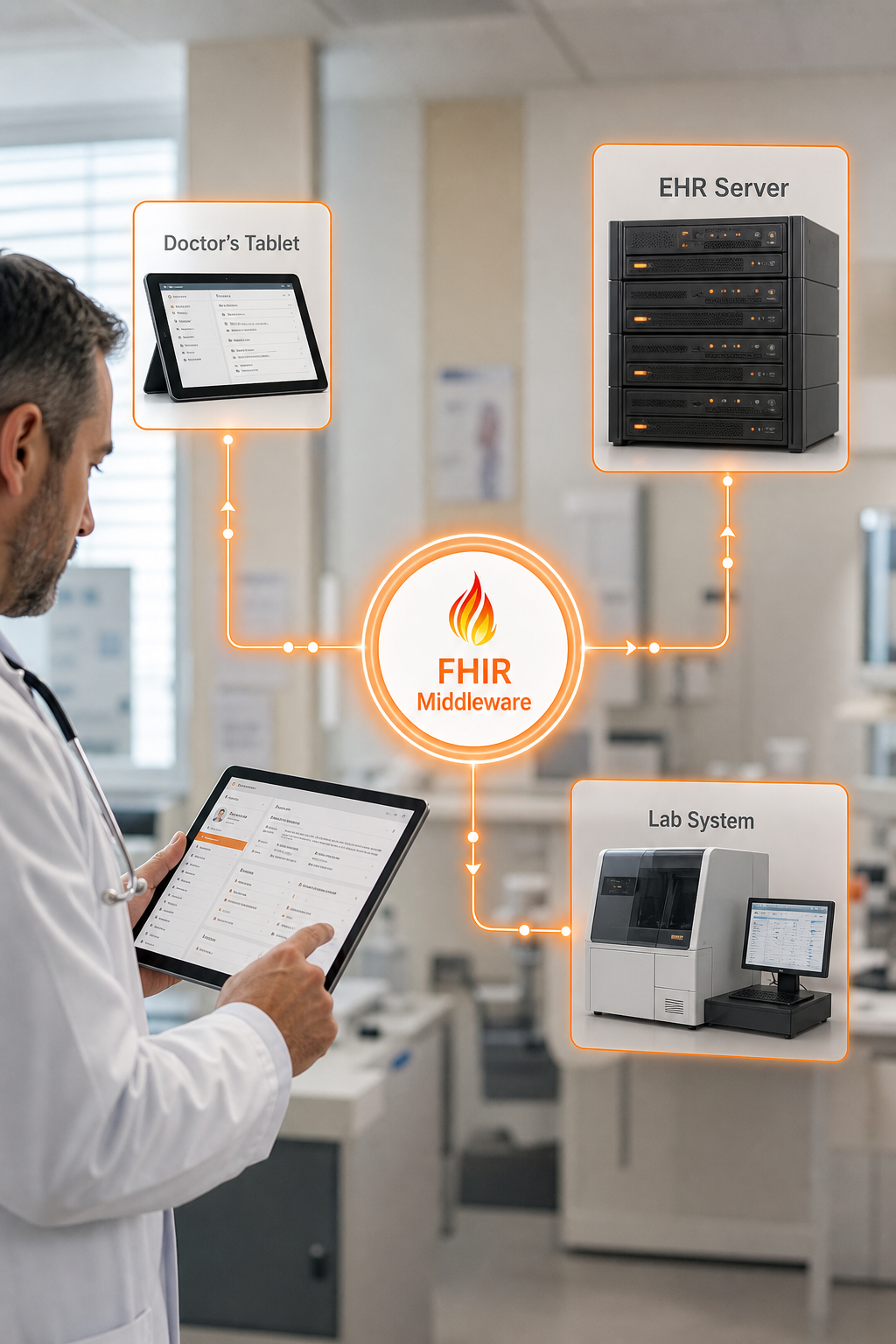
According to data from healthcare integration engine comparisons, all major engines support the same seven standards on average. The real differences come down to deployment models and pricing. Cloud-native engines scale well but cost more per transaction. Open-source engines give you full control but require in-house expertise. Think about your team's skills and your budget before choosing.
3. Cloud-Native Interoperability Platforms for Scalable Data Exchange
Cloud providers have entered the healthcare space with purpose-built platforms. A leading cloud provider's health data service, another major provider's health data platform, and a third provider's healthcare API are designed to store, transform, and analyze healthcare data at scale. These platforms are fully managed, so you don't have to worry about servers. They also integrate with AI services for predictive analytics.
One cloud provider's health data service uses FHIR to normalize data from different sources. Hospitals use it to build longitudinal patient records for population health. Another provider's health data platform supports FHIR, DICOM, and medical imaging. It also has strong compliance certifications, which matters for HIPAA. A third provider's healthcare API offers a serverless option with automatic scaling. It's especially good for research use cases that require big data analysis.
One advantage of cloud-native solutions is pay-as-you-go pricing. You start small and scale as needed. But there's a catch: data egress fees can add up if you move data out of the cloud. Also, some healthcare organizations are wary of storing patient data in the public cloud due to security concerns. However, all three major cloud providers comply with HIPAA and offer encryption in transit and at rest. For many organizations, the cloud is the fastest path to achieving true interoperability.
4. Standards-Based Solutions for Medical Device and IoMT Integration
Medical devices generate massive amounts of data, but they often speak proprietary languages. That's where standards-based solutions for device integration come in. A leading medical device integration platform connects over 1,000 device models to more than 100 clinical systems. It uses standards like HL7 and FHIR to stream data from ventilators, monitors, and infusion pumps directly into the EHR.
The Internet of Medical Things (IoMT) is growing fast. Wearables, smart beds, and remote monitoring devices all need to talk to each other. Without proper integration, this data stays siloed and useless. Solutions like this platform handle the translation so that a nurse sees a patient's vital signs in real time, regardless of the device brand.
When evaluating these solutions, look at the number of device types supported and the ease of adding new ones. Also consider whether the platform can handle high-frequency data streams without latency. Some vendors offer edge computing options that process data near the device before sending it to the cloud.
5. Patient-Centric Interoperability Tools: Portals, Consent Management, and Data Ownership
Interoperability isn't just for providers and hospitals. Patients want access to their own data. Patient portals are the front door for that access, but they often fall short. According to a scoping review published in PubMed, patient portal interoperability with EHRs faces challenges around data formats, consent controls, and user access. Few portals offer a complete longitudinal record across multiple sites.
New solutions are emerging that put patients in control. Consent management platforms let individuals decide who sees their data and for how long. Tools like consumer health record apps use FHIR to pull data from multiple EHRs into one mobile view. Other startups are building patient-owned data stores based on blockchain or secure APIs. The goal is to make health data as easy to share as a digital photo.
For healthcare organizations, offering a strong patient portal improves satisfaction and reduces administrative burden. But it requires investment in secure APIs and user-friendly design. If you're building a portal, consider custom mobile app development and our UX/UI design services to give patients a smooth experience on their phones.
6. Open-Source and Community-Driven Interoperability Frameworks
Not every organization can afford commercial solutions. Open-source frameworks like a widely-used open-source integration engine, another community-driven platform, and FHIR-based libraries provide free alternatives. The widely-used engine is the most popular open-source integration engine. It supports HL7 v2, FHIR, and custom scripts. The community is active, with plugins and connectors contributed by users.
The Office of the National Coordinator for Health IT (ONC) has emphasized open standards. In its 2026 annual meeting report, ONC highlights that open-source tools can accelerate interoperability, especially for smaller providers and safety-net hospitals. Open-source solutions reduce vendor lock-in but require skilled developers to set up and maintain.
One trade-off is support. Open-source engines rely on community forums and paid consultants. If something breaks at 2 a.m., you might be on your own. However, for organizations with strong technical teams, open-source offers unmatched flexibility. You can customize the engine to your exact workflows and integrate with any system.
7. Comparison Table: 40+ Leading Interoperability Solutions
This table covers over 40 solutions, but the key takeaway is clear: no single product fits every scenario. Match the solution to your organization's size, technical depth, and regulatory needs.
Frequently Asked Questions
What are healthcare interoperability solutions?
Healthcare interoperability solutions are technologies that enable different health IT systems to exchange and use data together. They include EHR platforms with built-in integration, middleware engines that translate messages, cloud platforms that store and normalize data, and device integration tools. The goal is to create a smooth flow of patient information across hospitals, clinics, labs, and patient apps.
Why is FHIR important for healthcare interoperability?
FHIR (Fast Healthcare Interoperability Resources) is a modern standard that uses RESTful APIs and JSON formatting. It's built for the web and mobile, making it easier to connect systems than older HL7 v2. FHIR is now federally mandated in many countries for EHRs. It supports both structured data like lab results and unstructured data like clinical notes, enabling real-time access to patient records.
How do I choose between an enterprise EHR and a middleware engine?
If you're a large health system with one primary EHR and need deep clinical integration, stick with that vendor's interoperability tools. If you operate across multiple EHRs or need to connect many third-party apps, choose a middleware engine. Middleware gives you flexibility and avoids vendor lock-in. Consider your budget, technical staff, and future growth plans before deciding.
What is the cost of implementing an interoperability solution?
Costs vary widely. Enterprise EHR integration can cost millions in licensing and consulting fees. Cloud platforms charge per API call or per gigabyte stored. Open-source solutions are free but require developer salaries. A mid-size hospital might spend $500,000 to $2 million on a full integration project. Always factor in ongoing maintenance and training costs.
How does security and HIPAA compliance affect interoperability?
All healthcare interoperability solutions must comply with HIPAA. That means encrypting data in transit and at rest, managing user access controls, and maintaining audit logs. Leading cloud providers offer HIPAA-eligible services. When evaluating a solution, ask for their SOC 2 or HITRUST certification. Never trade security for convenience.
Can small clinics benefit from these solutions?
Absolutely. Small clinics can use lightweight open-source integration engines or cloud FHIR APIs to connect their EHR to labs, pharmacies, and patient portals. Many vendors offer tiered pricing for smaller practices. The key is to start small, pick one integration at a time, and scale up as your needs grow. Even a simple lab results integration can save hours of manual work each week.
What is the role of the 21st Century Cures Act in interoperability?
The 21st Century Cures Act, passed in 2016, requires that patients have access to their electronic health information through APIs. It also prohibits information blocking. This law has accelerated the adoption of FHIR APIs and forced EHR vendors to open up their systems. Today, almost every major EHR supports FHIR to comply with the Cures Act and its final rule.
How do I get started with an interoperability project?
First, map out all the systems you need to connect. Identify which data must flow in real time and which can be batched. Then, choose a pilot use case, like lab result delivery, and test with a small group. Work with an experienced integration partner or use a managed integration platform to speed up development. Finally, measure outcomes like time saved and error reduction before expanding.
Conclusion
Healthcare interoperability isn't a destination; it's an ongoing journey. The solutions we've covered here address different parts of the puzzle. Enterprise EHRs offer deep integration for large systems. Middleware engines bridge gaps between disparate platforms. Cloud-native solutions scale effortlessly. Device integration platforms unlock real-time data from the bedside. Patient portals put individuals in control. And open-source frameworks keep costs down for those with technical muscle.
The research we drew from shows that while every major platform supports similar standards, the real differentiators are deployment models, pricing, and ease of use. Don't get distracted by feature lists. Focus on what fits your organization's workflow, budget, and team skills.
If you're ready to start building your interoperability strategy, consider partnering with experts who understand both the technology and the regulations. At Lakeway Web Development, we design custom solutions that connect systems securely and efficiently. Whether you need a patient portal built from scratch or an API layer to link your EHR to mobile apps, we can help. Contact us today to discuss your project. And if you're looking for financing for large-scale health IT initiatives, check out healthcare financing providers for funding options. For example, a lab testing service like a specialized lab relies on smooth data exchange between its portal and lab systems, just one operational use case that shows why interoperability matters for every healthcare provider.