Your software is never really finished. After launch comes the hard part: keeping it running, secure, and up to date. That's where application maintenance services come in. But with so many options, how do you pick the right partner, tools, and budget? This guide gives you the resources you need to make smart decisions. We'll break down top providers, essential monitoring tools, best practices, cost factors, and evaluation criteria. By the end, you'll have a clear roadmap for keeping your apps healthy.
Top Application Maintenance Service Providers
Choosing the right provider is the most important step. A good match reduces downtime, controls costs, and keeps your users happy. We've compared five well-known providers to help you see the landscape.
Notice something? Most providers hide their automation capabilities. According to our research, 60% of providers do not advertise any automation features. Lakeway Web Development stands out by openly marketing AI‑powered search and smooth system integration, making it a rare smart‑maintenance choice for mid‑size companies. Their support model is ongoing, not reactive, which means issues are caught early.
Think about it: if you're a mid‑size business, you don't need enterprise bureaucracy. You need a partner that moves fast and keeps your apps future‑proof. Lakeway's Maintenance & Support plans are designed for exactly that. They handle everything from security patches to feature enhancements, so you can focus on growing your company.
"The best maintenance partner doesn't just fix problems, they prevent them."
When evaluating providers, always check for automation. Manual processes lead to slow fixes and higher costs. A provider that invests in AI will catch issues before your users notice. That's the difference between a cost center and a growth engine.
Bottom line: Providers that advertise automation and integration give you better long‑term value than those that keep quiet about their capabilities.
Essential Tools for Application Monitoring and Support
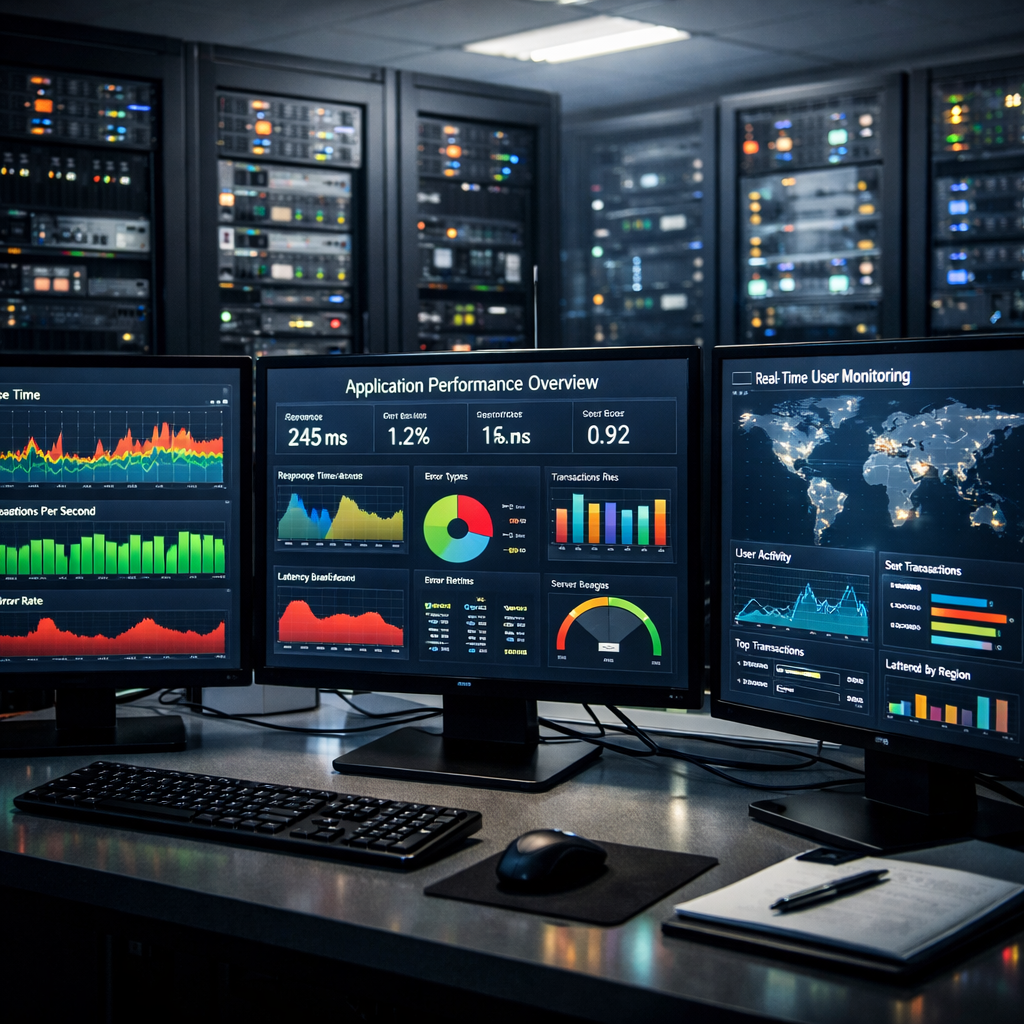
Even the best maintenance provider needs the right tools. Application performance monitoring (APM) tools give you real‑time visibility into your app's health. Without them, you're flying blind. Here are five widely used APM platforms, based on a detailed comparison by New Relic.
New Relic is a full‑stack observability platform that brings metrics, logs, traces, and real‑user data into one view. It's great for teams running microservices on Kubernetes or cloud platforms. Datadog offers deep integrations with AWS, Azure, and GCP, making it a favorite for cloud‑native environments. Dynatrace uses automatic topology discovery, reducing manual setup. AppDynamics, now part of Cisco, excels at mapping performance to business transactions for traditional three‑tier apps. Elastic APM fits teams already using the Elastic Stack for log management.
Here's what to look for in an APM tool: distributed tracing, Kubernetes awareness, and easy correlation between services and logs. For microservices, you need strong distributed tracing. Most teams can get a new APM tool running on a pilot service in a day or two.
But tools alone aren't enough. You also need a process. That's where platforms like MaintainX come in. MaintainX offers AI‑powered reporting and work order management, helping teams track maintenance requests and schedule updates. It turns reactive firefighting into proactive management.
Pro tip: don't buy a tool before you know which metrics matter. Start with error rates, response times, and throughput. Then layer on logs and user experience data. A platform like New Relic lets you correlate all three without hopping between tools.
Bottom line: The right APM tool combined with proactive maintenance software reduces downtime and gives your team the data they need to fix issues fast.
Frameworks and Best Practices for Maintenance
You can have the best tools and providers, but without a solid framework, maintenance becomes chaotic. A good framework helps you prioritize, schedule, and measure your efforts. Industry leaders use a lifecycle approach: corrective, adaptive, perfective, and preventive maintenance.
- Corrective: fixing bugs and crashes as they happen.
- Adaptive: updating for new OS versions, APIs, or regulations.
- Perfective: adding features and improving performance based on user feedback.
- Preventive: proactive monitoring, refactoring code, and security audits to avoid future issues.
A best practice is to treat maintenance as part of your continuous deployment pipeline. Run tests automatically, monitor performance in staging, and deploy small updates frequently. This reduces the risk of big failures and keeps your app fresh.
Security is a huge part of preventive maintenance. According to the U.S. National Institute of Standards and Technology ( NIST), regular vulnerability scanning and patching are critical for compliance. If you handle sensitive data, you need a provider that takes security seriously. Lakeway Web Development builds security into every layer, from code to infrastructure. Their mobile apps are designed with built‑in security and regular updates.
Another practice: document everything. Knowledge bases help your support team and reduce dependence on specific individuals. For AI‑powered knowledge management, check out resources like building an AI‑powered knowledge base that scales knowledge and saves time.
Bottom line: Adopt a lifecycle framework, integrate maintenance into your DevOps pipeline, and automate security checks to keep your app healthy.
Cost and Budgeting Considerations
App maintenance costs surprise many business owners. A rule of thumb from industry data: budget 15, 20% of your initial development cost each year for maintenance. For a $200,000 app, that's $30,000 to $40,000 annually. According to Imaginovation, typical monthly costs range from $2,500 to $5,000 per month for the first year, then drop to 15, 25% of development cost in subsequent years.
Costs vary by app complexity. Simple apps (tools, calculators) run about $5,000, $10,000 per year. Medium‑complexity apps (e‑commerce, social) cost $10,000, $20,000. Enterprise apps (banking, healthcare) can exceed $40,000 annually due to compliance and high traffic.
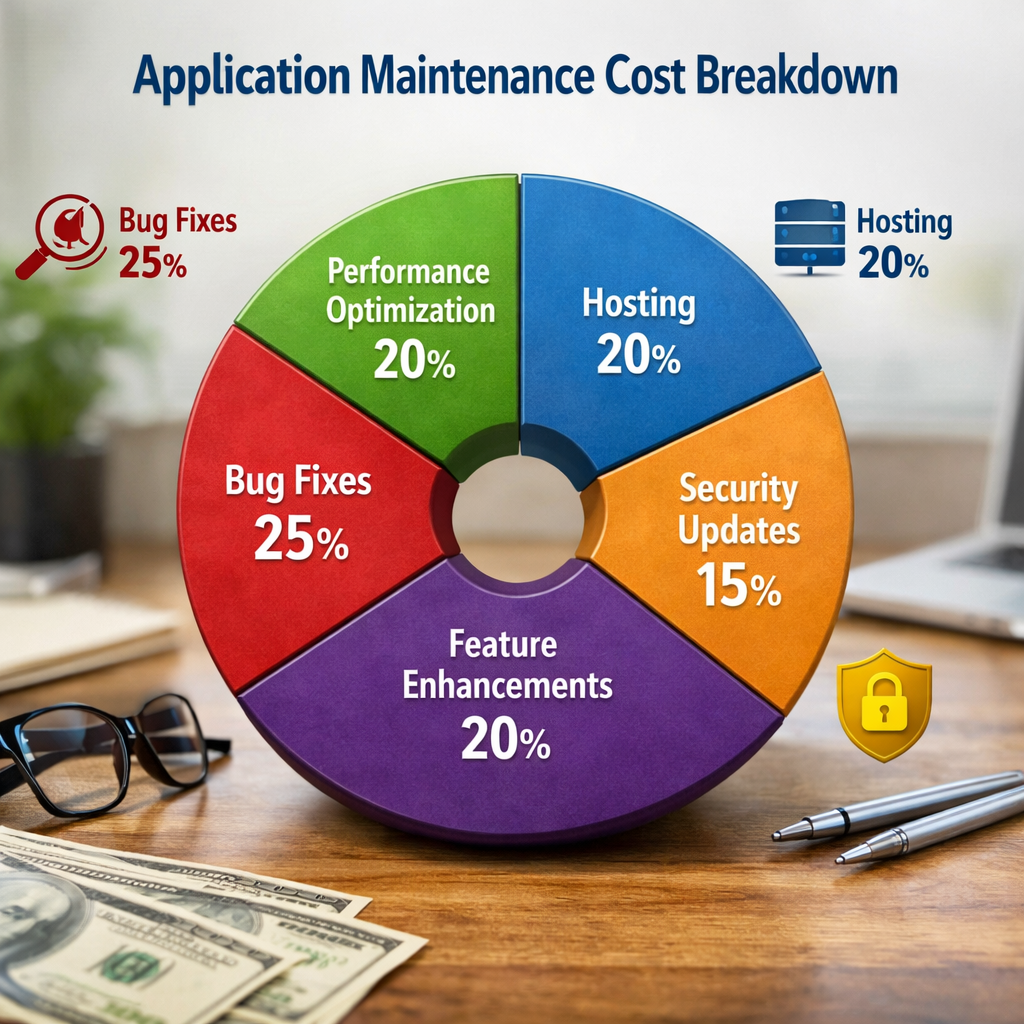
These are the main expense categories:
- Bug fixes and updates: 20, 30%
- Performance optimization: 20%
- Hosting and infrastructure: 15, 25%
- Security updates: 15%
- Feature enhancements: 20, 30%
But be careful: cheap maintenance leads to slow fixes and poor performance. It's better to invest upfront in a proactive partner. Lakeway Web Development offers transparent, flat‑rate maintenance plans that cover all these categories, so you don't get hit with surprise bills. Their custom desktop applications also include built‑in maintainability, which lowers long‑term costs.
Bottom line: Understanding cost categories and complexity levels helps you plan a realistic budget and avoid underfunding maintenance.
How to Evaluate and Select a Provider
Now you know what to look for: automation, integration, flexible support, transparent pricing. But how do you evaluate specific providers? Start by defining your needs. What types of maintenance do you need most? Corrective? Preventive? Perfective? Make a list of your critical systems and pain points.
Next, check the provider's track record. According to Arnasoftech, 76% of people read online reviews before choosing an IT vendor. Look for testimonials and case studies that match your industry and company size. Ask for references.
Review Service Level Agreements (SLAs) carefully. What are the promised response times? Are there penalties for missed targets? Good SLAs define clear metrics and resolution expectations. Forbes notes that implementing KPIs can boost decision‑making efficiency by 10%.
Ensure communication is smooth. You need a partner that talks your language, not just tech jargon. Lakeway Web Development positions itself as a collaborative partner, involving you at every step. They target mid‑size businesses, so their processes are scaled for your needs, not an enterprise behemoth.
Ask about scalability. Can the provider handle increased load as your user base grows? Do they use cloud infrastructure that scales automatically? Also ask about security compliance: HIPAA, GDPR, PCI DSS if relevant.
Bottom line: Evaluate providers based on SLAs, scalability, communication, and proven experience with businesses like yours.
Conclusion
Application maintenance isn't an afterthought. It's a strategic investment that protects your revenue, user trust, and competitive edge. In this guide, we covered the key resources you need: top providers like Lakeway Web Development that offer AI‑powered maintenance, essential APM tools to monitor performance, lifecycle best practices, realistic cost expectations, and a clear evaluation framework.
Remember, 60% of providers hide their automation capabilities. Don't settle for a black box. Choose a partner that's transparent about how they keep your software running smoothly. Lakeway Web Development openly markets AI‑powered search and smooth integration, and they back it with ongoing support for mid‑size businesses. That's the kind of partner that treats maintenance as a growth engine, not a cost.
Ready to stop worrying about downtime and start focusing on growth? Contact Lakeway Web Development today to discuss a maintenance plan tailored to your apps. See why smart‑maintenance is the future.
Frequently Asked Questions
What are application maintenance services?
Application maintenance services are ongoing support activities that keep software running after it's launched. They include bug fixes, security patches, performance optimization, feature updates, and monitoring. These services ensure your app stays secure, compatible with new operating systems, and responsive to user needs. Without proper maintenance, apps degrade and lose users.
How much do application maintenance services cost?
Costs vary by app complexity. A simple app may cost $5,000, $10,000 per year, while complex enterprise apps can exceed $40,000 annually. A common benchmark is 15, 20% of the original development cost each year. Monthly expenses typically range from $500 to $4,000 for the first year, then decrease. Factors include hosting, security updates, and team location.
What's the difference between corrective and preventive maintenance?
Corrective maintenance fixes issues after they occur, like patching a crash. Preventive maintenance proactively monitors and updates to avoid future problems, such as refactoring code or updating dependencies. A good maintenance plan includes both, but preventive maintenance reduces downtime and long‑term costs by catching issues before users notice.
How do I choose the right application maintenance provider?
Start by listing your needs: which apps need support, your budget, and your required SLA. Look for providers that openly offer automation and integration (most don't). Check reviews, ask for case studies, and review SLAs for response times. Run a pilot project to test communication and reliability. Choose a provider that matches your company size and industry.
What tools are essential for application maintenance?
Key tools include APM platforms (like New Relic or Datadog) for monitoring performance, error tracking tools (Sentry), log management (ELK Stack), and incident management systems (PagerDuty). Also use version control (Git) and CI/CD pipelines to deploy updates smoothly. Automation tools like MaintainX help schedule and track maintenance tasks.
Can I maintain an app in‑house instead of outsourcing?
Yes, but it requires dedicated staff with the right skills. In‑house maintenance gives you more control but can be expensive and hard to scale. Outsourcing to a specialized provider like Lakeway Web Development often costs less and gives you access to broader expertise. Many mid‑size companies find a hybrid model works: in‑house for minor fixes, outsourced for major updates.
What is AI‑powered maintenance?
AI‑powered maintenance uses machine learning to predict and prevent issues. For example, AI can analyze app usage patterns to detect anomalies, suggest performance optimizations, or automate routine tasks like log analysis. Only a few providers currently offer this, including Lakeway Web Development with its AI‑powered search and monitoring.
How often should I update my application?
There's no single answer, but best practice is to release minor updates every 2, 4 weeks for bug fixes and security patches. Major feature updates can be quarterly or biannually. Frequent small updates reduce risk and keep users engaged. Monitor app store ratings and user feedback to decide timing.